Hallie Clarke Facebook photo
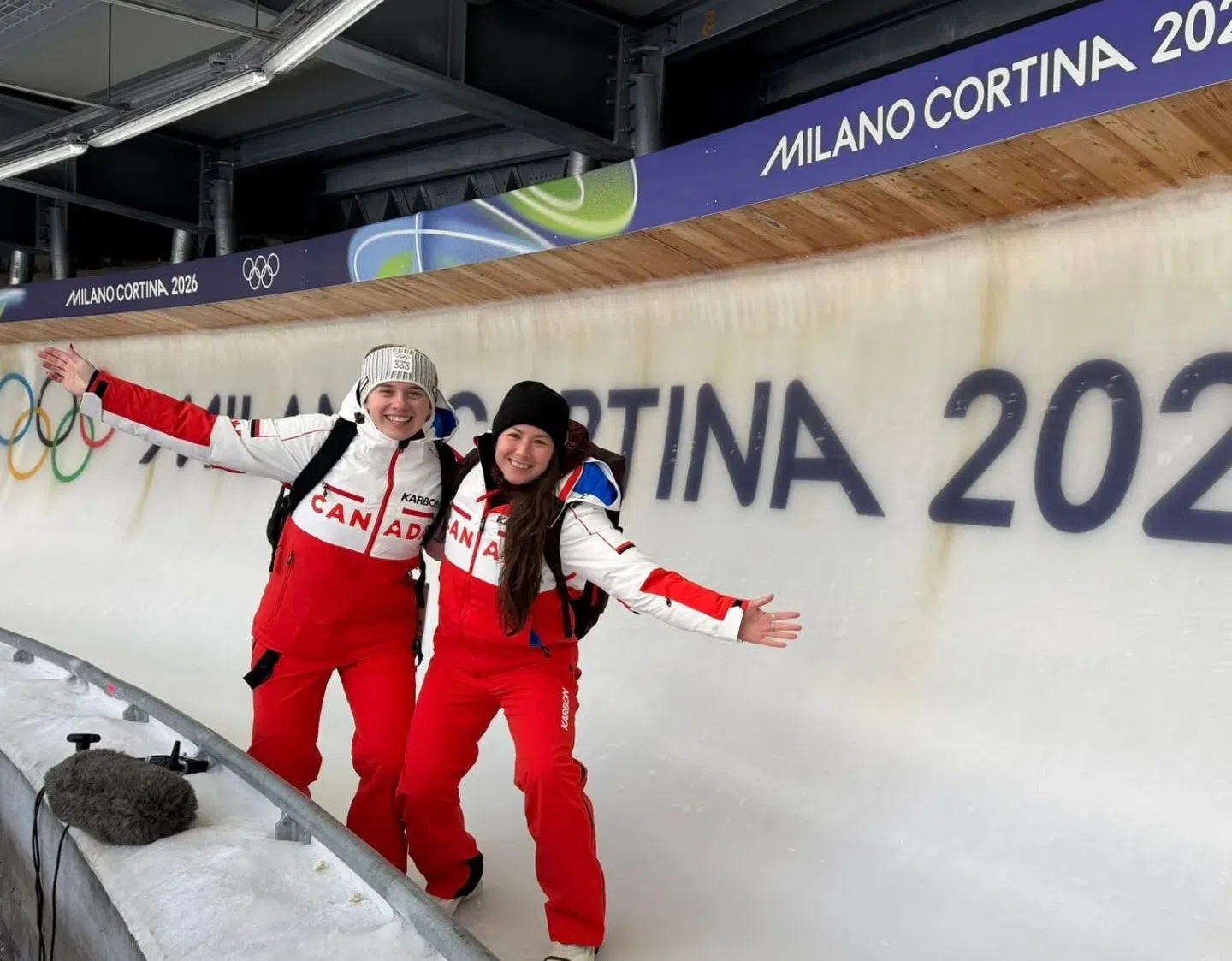
While she didn’t reach the podium, Brighton’s Hallie Clarke made her hometown proud in her world Olympic debut at the Cortina Sliding Centre, finishing 19th overall in women’s skeleton on Saturday, Feb. 14, 2026.
The 21-year-old representing Team Canada also pulled off one of the top times – and her personal best – in the final heat today as the 11th fastest down the track.
She finished with a cumulative time of 3:53.02 after four heats, two of which were today and two yesterday.
That was the Municipality of Brighton’s Caroline Birch, who teamed up with colleague Vicki Hallam, to put on an Olympic watch party in Clarke’s honour at the Owen Gibb Community Hall Saturday.

Clarke managed to move up two spots since her first challenging heat Friday morning, where she finished 21st with a time of 58.51.
She then inched up with the 19th-fastest finish after heat two with a time of 58.22 and then slid into 17th by heat three with a time of 58.31. She then maintained her overall 19th position in the final heat of the games, where she had a remarkable run time of 57.98 after starting seventh.
Four-time Olympian Janine Flock took home her first gold medal representing Austria after securing first across all four official heats and was followed by Germany’s Susanne Kreher in second and Jacqueline Pfeifer, who took home bronze.
In skeleton, the times across all four heats are combined for the lowest cumulative total or “total time” and that is how winner is declared, as detailed by the Olympics.
In comparison, Flock’s total time came in at 3:49.02, Kreher at 3.49.32 and Pfeifer at 3.49.46.
To put Clarke’s final run into perspective, again, she ripped down the track and finished at 57.98 – gold medallist Flock’s final run time in heat four was 57.28, meaning the difference was just 0.7 seconds.
“I’m extraordinarily excited – I couldn’t be more happy for her,” said Hallam, at the community centre Saturday, which was packed with everyone from family and friends to everyday residents, who again, didn’t hesitate to answer the call to honour Clarke from home, joining people across the region and nation cheering on the rising skeleton star.

A total of 25 athletes dove headfirst down the ice and often exceeded more than 100 km/h at times while in Italy for the Milano Cortina Winter Olympics – and it was a challenging track.
Clarke also consistently increased her speed across all four heats.
In heat four, she clocked in at her highest at 120.96 km/h – her lowest speed in that same heat was 118.89 km/h and she only got faster as she zipped down the track.
Among the other athletes competing in the women’s skeleton was veteran Jane Channell, who was also representing Canada for a third time, hailing from North Vancouver.
Channell, 37, came in 18th, with a total time of 3:52.96 after four runs.
In an article by Daniel Squizzato on Olympic.ca Saturday, Clarke called her Olympic results “bittersweet” and was quoted as a little disappointed.
But she was also quoted saying: “I didn’t have expectations for myself coming into this. I was a bit hard on myself but I’m really proud of how I picked it up today and I had a huge PB (personal best) on the last run.”
She was also seen smiling at the end of her fourth run.
And while she acknowledged this quadrennial cycle has featured a lot of highs and lows, she also said she’s already setting her sights on the French Alps 2030.
And although Clarke didn’t medal, she’s still widely being recognized as “a bright light” for the next generation of gliders for Canada (with such terms used repeatedly by announcers throughout the games.)
At just age 21, Clarke already has several impressive wins under her helmet, including the title of the youngest world champion ever in women’s skeleton after capturing the championship crown at age 19 in Winterberg, Germany – an emotional win captured on camera that touched people’s hearts around the globe.
This same win two years was also historic in that she became the fifth Canadian to claim this top spot on the podium that year.
Just a year later, she took the world junior women’s championship crown, making her the first-ever to hold both at the same time in 2025.
She started skeleton at 14 years old after a move to Calgary and was a competitor by the following year. She previously told MBC her journey into the sport just happened by chance as she walked past a sign that read “Learn to push.”

She recalled thinking “that sounds so Canadian,” and while she got some bumps and bruises along the way giving it a try (and more as her momentous journey continued) she then simply “fell in love with it.”
Back in 2023, Clarke also took home the under-20 world crown, and she previously represented Team Canada at the Lausanne 2020 Winter Youth Olympic Games and finished 12th.
And these are just a few of her wins.
But even before age 14, she was dreaming big with hopes of one day competing at the Olympics, growing up watching figure skaters and Olympians like Tessa Virtue and Scott Moir. She talked about her aspirations to qualify with MBC back in 2024 when Brighton welcomed Clarke home with an epic “Hallie’s Homecoming” celebration to commemorate her historic achievements.

Locally, she’s often referred to as “Brighton’s superstar” – but now she is officially an Olympian, hailing from the quaint community of Brighton, Ont.
In terms of how Saturday’s Olympic watch party came together, Birch said it’s been in the works for quite some time.
“And then about a month ago, when Hallie was named to the Olympic team, I came back to Vicki and we said: ‘I think we can do this.’”
Of course, then the team had to account for time changes in Italy, get the arena schedule lined up and the centre set up and more, but all the pieces ended up falling into place.

“And it was a great turnout today,” added Birch.
(Written by: Sarah Hyatt, with files from York Bell-Smith)