socastcmsRssStartOldies 100.9 News staffsocastcmsRssEnd
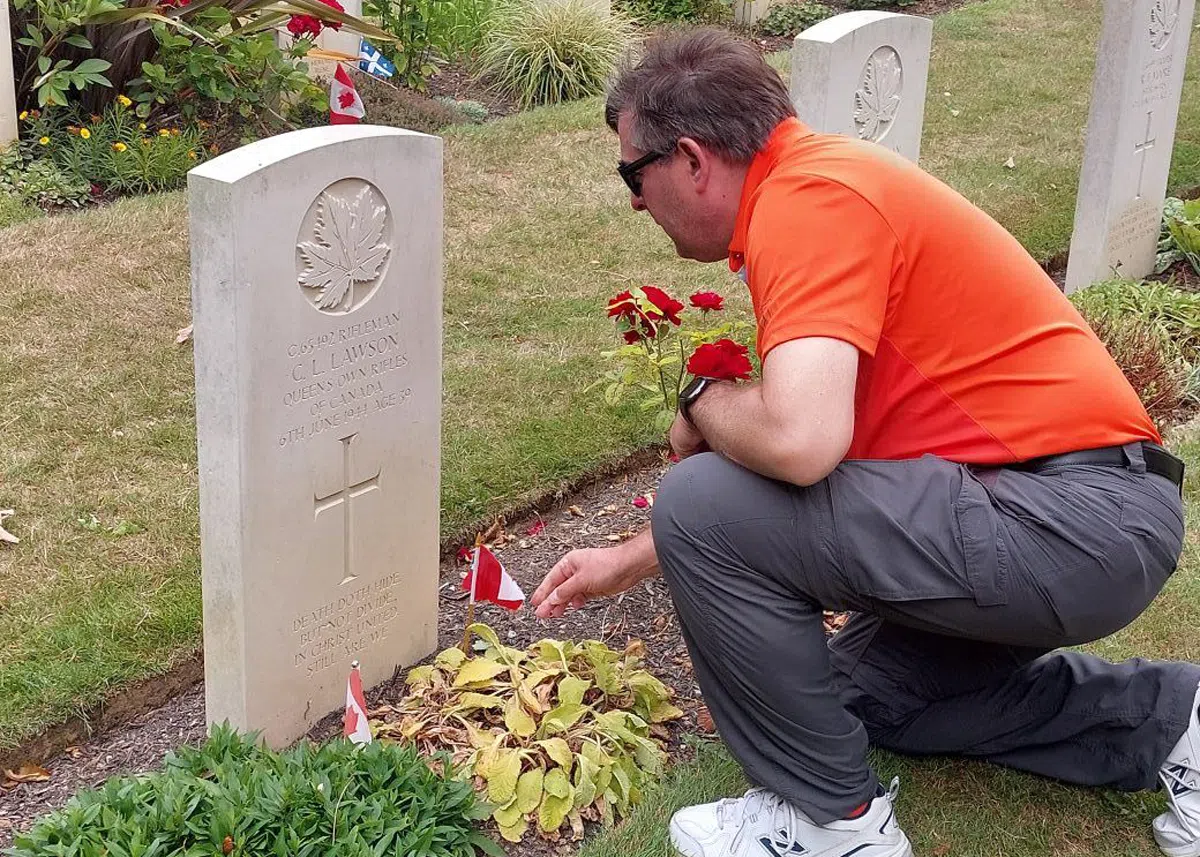
Eighty-one years ago, Canadians stormed the beaches of Normandy on June 6, 1944.
The allied attack on what would become widely known as D-Day and the largest-scale seaborne invasion of all time claimed hundreds of Canadian soldiers’ lives that day alone – including Brighton’s Clarke Lynson Lawson, who survived the landing on Juno Beach but was killed in action later liberating the village of Anisy, which was the last battle of that day.
His sacrifice has not been forgotten – not in Brighton, Ont., and not in Anisy, France, which are now “twinned” communities.
Earlier this year, Brighton Mayor Brian Ostrander visited France and joined Anisy leaders and residents there in honouring rifleman Lawson. The experience was life-changing in terms of how he now views Canada’s remembrance period.
But first, Ostrander takes us back to June 6, 1944.
“Sadly, a Brighton soldier named Clarke Lawson perished in Anisy that day.”
According to Veterans Affairs Canada, victory in the Battle of Normandy came at a terrible cost. Depending on historians’ accountings and definitions, the death toll on D-Day alone for Canadians ranged from 340 to 381. However, the more commonly cited figure appears to be 359. Over the course of about two-and-a-half months, thousands more would die fighting in Normandy, were wounded and would go on to carry lifetime injuries long after returning home.
Many of the fallen – including Lawson – lie buried in France in the Bény-sur-Mer Canadian War Cemetery, as well as the Bretteville-sur-Laize Canadian War Cemetery.
As for when the communities of Brighton and Anisy “twinned” that journey initially started in 2017 after Anisy named a road in honour of Brighton’s fallen soldier to Rue Clarke Lawson, said Ostrander, adding the curator of the Queen’s Own Rifles of Canada Regimental Museum and Archive – who has Brighton ties – reached out about year or so later about this tribute.
“So I immediately reached out to the mayor of Anisy and thanked him for this great honour, apologized for not knowing about it, and asked if he and his council would consider some sort of twinning agreement.”
Mayor Nicolas Delahaye “got right back to me and … both councils passed motions agreeing to twin.”
“So again, fast forward a couple of years (and) Tammy (Ostrander’s wife) and I have always wanted to visit France.”
Planning the vacation, Ostrander recalled saying: “We really should take the chance to drop into Anisy and at least say hello and if nothing else to say that we’ve been there given it’s our twin community.”
Again, he reached out to Delahaye, this time inquiring whether there would be a willingness to host them for a day while going through Normandy.
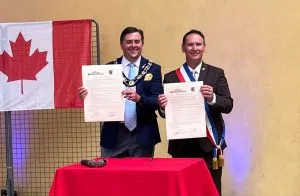
Their trip earlier this year ended up coinciding with Fête Nationale – which Canadians often refer to as Bastille Day – and they were invited to participate. Both communities’ leaders went on to officially sign a twinning charter, give speeches and lay a wreath to commemorate Lawson at the site where he perished.
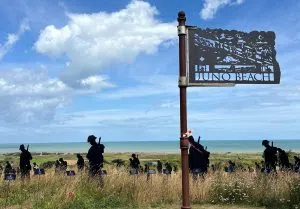
“The following day, the mayor and his wife toured Tammy and I to Juno Beach where the Queen’s Own Rifles landed and where Clarke landed to ‘Canada House,’ which was one of the landmarks that they used to land from afar … on the beaches.”
“Canada House” was the first home liberated on D-Day.
During their trip, Ostrander also visited several other sites where they were able to honour Lawson for Brighton.
“Just to give thanks,” said Ostrander.
There have been reports that Lawson was the only allied soldier to be killed in the mission to Anisy in 1944, but MBC hasn’t been able to 100 per cent confirm this.
Brightonians also ensured Ostrander was equipped with gifts for Anisy – from donated photos and paintings of the iconic Presqu’ile lighthouse, to a copy of Dan Buchanan’s book “The Wreck of HMS Speedy,” and a flag that was immediately flown at town hall.
“The two days we spent in Anisy and on Juno Beach with Mayor Delahaye and his wife were just incredible. To say they were emotional would be such an incredible understatement.”
Ostrander has been sharing his experience throughout Remembrance Day events here in recent days.
“The whole experience just made me realize we don’t do these commemorations often enough,” he said. “We do remembrance once a year …”
During their Fête Nationale, Ostrander recalled an elderly citizen talking about her experience as a five-year-old during the war.
“(She) remembers having a Nazi soldier put a rifle in her chest. And I don’t know what the command or order was, but that’s how frightening (this was) and to have lived with that for 80 years … She not just remembers the day that Anisy was liberated – she remembers the occupation.”
“My biggest takeaway was that the people of Normandy have made remembrance their call and treat every day as a liberated, thankful day.”
Following Ostrander’s trip, back in August, Brighton also privately hosted a family from Anisy that had stopped at the cenotaph to honour Lawson while on their way to Toronto.
Lawson was born on May 8, 1905, in Brighton. He was killed in action at age 39, according to military records.
He was the son of George Lynson Lawson and Sarah Elizabeth Maybee and a husband to Stella Grace Lawson.
According to the Queen’s Own Rifles of Canada Regimental Museum and Archive, he attended Lawson Settlement School, then Brighton High School and later Kingston Dairy School.
He enlisted in the Second World War with the Midland Regiment on Nov. 15, 1940, in Cobourg and went overseas on March 22, 1943, where he was posted to the Canadian Infantry Reinforcement Unit and then transferred to the Queen’s Own Rifles on June 11, 1943.
Eighty-one years after his sacrifice, he continues to bring people together, regardless of geography.
(Written by: Sarah Hyatt)